
Research and Educational Data Sets
Access International Distributed Network Telescope datasets, de-identified NetFlow data, internet measurement science, and other research repositories to support teaching and learning

Merit Research advances the future of networking, cybersecurity, artificial intelligence, quantum networking, research computing, and digital opportunity by connecting discovery with real-world impact. We bring together researchers, universities, students, industry, government, and community organizations to solve complex challenges that strengthen research, education, and public service. Our work spans both fundamental and applied research, improving the security, performance, and resilience of Internet infrastructure while exploring emerging technologies that will shape the future. We transform research into practical solutions that benefit our members and the communities they serve.
Collaboration is at the heart of everything we do. Merit’s unique position as both a trusted network operator and research organization allows us to bridge academic scholarship with operational expertise, creating opportunities that no single institution could accomplish alone.



We invite researchers, educators, nonprofit organizations, and industry to join us in advancing discovery and innovation.
Access International Distributed Network Telescope datasets, de-identified NetFlow data, internet measurement science, and other research repositories to support teaching and learning

Connect to a local and global network of collaborators through state- and federally funded research, advancing innovation across technology and society

Build with the partnerships and infrastructure needed to move quantum networking from the laboratory into real-world environments

Access integrated research environments that connect AI, machine learning, and advanced data processing with institutional data, Merit datasets, and national research repositories

Leverage Internet-scale research data to develop next-generation cybersecurity tools, analytics, and defensive capabilities in secure environments

Create meaningful student research experiences by partnering with faculty to develop projects that deliver real-world impact while advancing scientific discovery
Merit Research has transformed groundbreaking ideas into real-world impact. We helped build the modern Internet through leadership in NSFNET and advanced networking research, continue to protect it through Internet-scale cybersecurity research, AI-powered threat detection, and shared security infrastructure, expand digital opportunity through broadband planning, Internet freedom research, and community-based initiatives, and accelerate scientific discovery by providing researchers with access to advanced computing, national research platforms, quantum networking, and AI-ready infrastructure.
The International Distributed Network Telescope (INDNT) expands Merit Network’s decades of leadership in Internet-scale cybersecurity research by connecting network telescopes from research and education institutions across the United States into a shared national research infrastructure. Building upon the foundation established by ORION and the NSF, INDNT enables researchers to observe cyber threats, Internet disruptions, and emerging attack patterns across multiple geographic vantage points while creating one of the largest collaborative cybersecurity datasets available to the research community. The project advances Internet resilience, accelerates cybersecurity discovery, and fosters collaboration among universities, research organizations, and network operators working to understand better and protect the global Internet.
Project Compass is a USDA-funded initiative that helps communities transform broadband access into lasting digital opportunity. Working alongside local governments, libraries, schools, and community organizations, the project combines broadband planning, digital inclusion research, cybersecurity education, and community engagement to identify barriers to connectivity and develop practical solutions. By helping residents build digital skills while supporting local leaders with data-driven planning, Project Compass strengthens economic opportunity, civic participation, and safe access to an increasingly digital world.
SCOPE-X is an NSF-funded collaboration between Merit Network and Texas A&M University focused on transforming Internet-scale cybersecurity data into high-quality datasets for artificial intelligence and machine learning research. The project modernizes the ORION data pipeline through advanced processing, enrichment, and analytics that improve the quality, accessibility, and scientific value of network telescope data. The resulting infrastructure enables faster cybersecurity discovery, more reproducible research, and next-generation AI applications for cyber defense.
Building on previous work with Texas A&M University, this research initiative advances the next generation of network telescope analytics through threat intelligence integration, high-performance packet capture, and interactive data visualization. The project enriches Internet-scale cybersecurity data with additional context, evaluates technologies for processing increasingly large traffic volumes, and develops new ways for researchers to explore and access network telescope insights. These improvements strengthen both cybersecurity research and the long-term sustainability of ORION’s research infrastructure.
In partnership with the University of Southern California, this NSF-funded project develops new methods to improve the resilience and reliability of the growing IPv6 Internet. Rather than relying on traditional Internet scanning, the research uses passive network observations to detect outages, routing problems, and partial connectivity issues that would otherwise remain hidden. The resulting tools help research and education network operators improve network reliability while providing new data and methodologies for studying the modern Internet.
Through a collaboration with Georgia Institute of Technology, this NSF-funded project is transforming traditional network telescopes into adaptive, dynamic research infrastructure. By continuously identifying unused address space across Merit Network, the system expands visibility into Internet activity while making network telescopes more resistant to blacklisting by malicious actors. The project enhances ORION’s ability to capture new cybersecurity data, enabling more accurate Internet measurements and creating new opportunities for research on emerging cyber threats.
In collaboration with the University of Michigan, this NSF-funded project develops new statistical and artificial intelligence methods to monitor Internet performance at an unprecedented scale. By combining active network measurements with data from Netrics, Moonshot, M-Lab, Ookla, and other sources, researchers create detailed maps of Internet performance, detect network anomalies, and improve situational awareness for network operators. The project advances both Internet measurement science and practical tools that improve network performance for communities across Michigan and beyond.
IRIS is an NSF-funded cybersecurity research infrastructure that provides large-scale network monitoring and security analytics for Merit Network and its member institutions. By passively analyzing multi-100 Gbps Internet traffic using advanced open-source security tools, IRIS delivers threat intelligence, intrusion detection, and situational awareness that many organizations could not otherwise afford. Beyond improving cybersecurity operations, IRIS serves as a living research platform supporting innovations in networking, cybersecurity, artificial intelligence, and data science while creating valuable datasets for the broader research community.
In partnership with North Carolina Central University and the University of Illinois Urbana-Champaign, this research examines how young people develop artificial intelligence literacy through the combined influence of schools, families, libraries, community organizations, and broader social systems. Using a socio-ecological framework, the project investigates why access to AI education differs across communities and how those differences affect workforce readiness, civic participation, and educational opportunity. The findings will provide evidence-based recommendations that help educators, policymakers, and communities build more equitable pathways to AI readiness while ensuring that AI literacy supports both economic mobility and democratic participation.
Merit is launching a phased LoRaWAN pilot to explore how low-power sensor networks can support smart agriculture, environmental monitoring, research, and community infrastructure across Michigan. By deploying a small number of gateways and sensors in real-world environments, the project will help evaluate technical requirements, build operational expertise, and identify opportunities for larger statewide deployments. Interest in the initiative is already growing, with governing members including Michigan State University and Oakland University expressing interest in participating. The pilot will position Merit to better support future research collaborations, attract new funding opportunities, and help communities harness connected technologies that improve decision-making, sustainability, and public services.

Analyzing 22 million unsolicited Internet packets to uncover coordinated IoT reconnaissance campaigns, persistent Telnet exploitation, and large-scale attack patterns targeting vulnerable connected devices.

Developing a new telemetry framework that analyzes over 100 million network flows to verify whether real-world network behavior matches intended security policies, enabling more intelligent and autonomous network management.

Analyzing 192 million darknet packets to reveal how AI-assisted bots evade traditional intrusion detection systems, exposing critical security gaps in industrial control systems and the Industrial Internet of Things (IIoT).

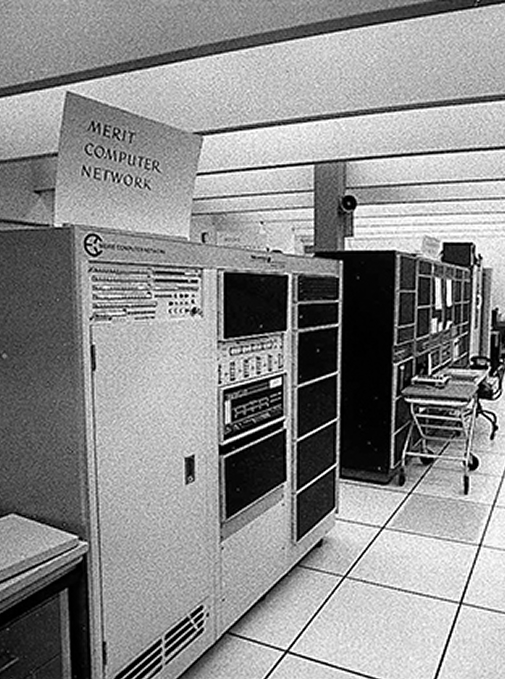
Merit’s research legacy began in 1966 with a vision to connect researchers through shared computing resources. That spirit of innovation led Merit to build and operate the NSFNET backbone in partnership with IBM, MCI, and the National Science Foundation, helping transform the early Internet while advancing foundational technologies such as BGP, RADIUS, and CIDR that still power global networking.
That same philosophy continues to define Merit Research today. Rather than separating research from operations, Merit treats its production network as a living laboratory where real-world challenges drive scientific discovery. This unique environment allows researchers to study Internet infrastructure, cybersecurity, broadband, AI, quantum networking, and digital opportunity at a scale few organizations can match. From more than two decades of Internet-scale cybersecurity research through the ORION and INDNT network telescopes to statewide initiatives that expand digital opportunity and strengthen broadband planning, Merit translates research into practical solutions. By combining operational expertise with academic collaboration, Merit continues to advance the technologies, policies, and partnerships that keep the Internet secure, resilient, and accessible for the communities that depend on it.
It appears your browser is blocking access to our web forms.
Please see this support article for more information.