International Distributed Network Telescope (INDNT)
About the Project
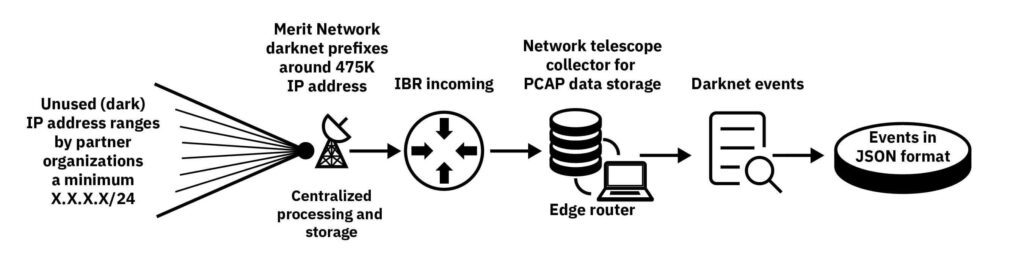
The International Distributed Network Telescope (INDNT) is an international initiative led by Merit Network to build a collaborative infrastructure for analyzing unsolicited Internet traffic—also known as darknet data.
A network telescope is a system that monitors unused portions of the Internet’s address space to collect and analyze traffic that was not intentionally sent to a live host. This data offers a unique window into global Internet activity, allowing researchers to study scanning behavior, attacks, and other anomalous events that help strengthen cybersecurity.
Merit currently operates the ORION Network Telescope, which has already provided significant insights into malicious Internet activity. The INDNT expands this effort to an international scale, enabling distributed data collection and analysis across multiple institutions and research and education (R&E) networks throughout the United States and beyond. The initiative already includes participation from more than 37 institutions internationally and continues to grow.
Why Collaborate
By joining INDNT, your organization contributes to a growing community of researchers, educators, and network operators dedicated to improving cybersecurity visibility and resilience.
Participating institutions and researchers can:
- Collaborate on cutting-edge cybersecurity research using real-world darknet datasets.
- Contribute unused IP address space to expand telescope coverage and improve visibility into diverse Internet regions.
- Access anonymized, curated data for machine learning, traffic analysis, and Internet measurement studies.
- Co-author research papers and publications based on INDNT data and findings.
- Strengthen cyber resilience through data-driven insights and partnerships with Merit, academia, and national cybersecurity organizations.
Data for Research and Education
INDNT builds on Merit’s extensive existing datasets, offering a valuable resource for both researchers and educators.
- For researchers: Datasets provide real-world data for exploring Internet phenomena, attack trends, and network security analytics.
- For educators: These datasets can be used in cybersecurity, data science, and networking courses to teach students how to analyze and interpret Internet-scale data.
- For research labs and institutions: INDNT data can be directly integrated into ongoing research projects, serving as a foundation for new discoveries, publications, and collaborations.
Ways to Collaborate
There are several ways to join the INDNT effort:
- Use INDNT data in your research or lab: Apply the datasets in your own studies, analysis, or teaching to advance cybersecurity and Internet measurement research.
- Host a sensor node: Deploy a telescope sensor at your institution to contribute data from a new vantage point.
- Loan unallocated IPv4 address space: Offer unused IP address blocks to expand observation coverage.
- Share information: Help spread the word to collaborators, researchers, and university partners who may benefit from INDNT data.
- Join the research collaboration network: Participate in data analysis, co-author studies, and contribute to national-scale research outcomes.
Previous Engagements
THE QUILT 2025
- Dr. Pierrette Dagg, Merit Network
- Dr. Shereen Ismail, Merit Network
- Ammar Alomari, Merit Network
Research Computing at Smaller Institutions (RCSI 2025)
National Distributed Network Telescope (NDNT)
- Dr. Shereen Ismail, Merit Network
TechEX24
- Dr. Shereen Ismail, Merit Network
TechEx25
BoF: Towards a National Distributed Network Telescope for Cybersecurity Research
- Dr. Pierrette Dagg, Merit Network
- Dr. Shereen Ismail, Merit Network
TechEx25
- Dr. Shereen Ismail, Merit Network
Publications
Machine Learning for Anomalous Unsolicited Network Traffic Detection by Observing ORION Network Telescopes, S. Ismail, S. Dandan, M. King, 2025
Understanding Honeypots: Observing Malicious Activities Over Telnet, S. Ismail, S. Dandan, M. King, 2025